
Michael Bloomberg and Lei Jun: Wealth and Business Compared
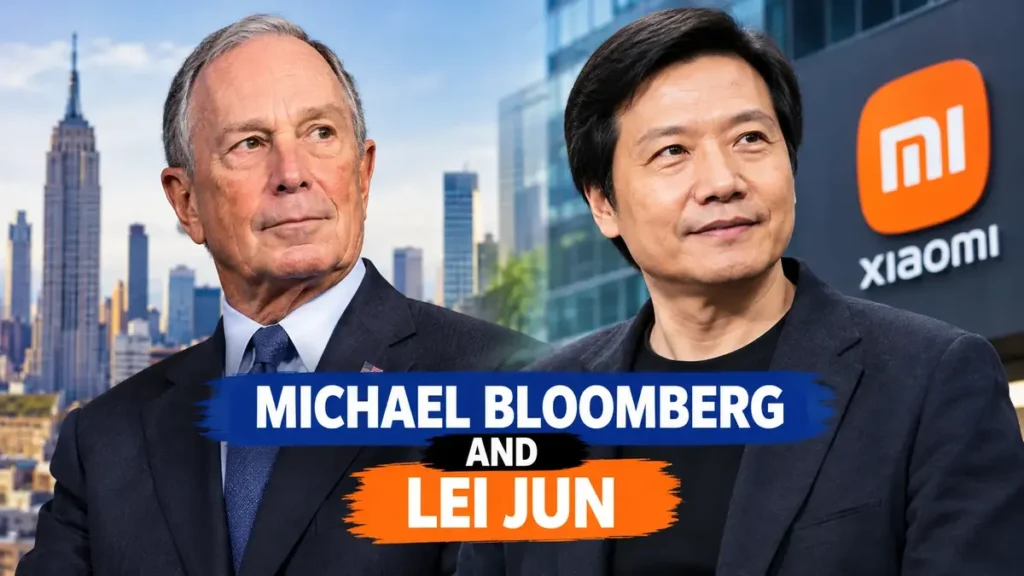
You want to understand how two billionaires from opposite sides of the globe built their empires, but most comparisons stop at headline net worth numbers. That leaves you with shallow takeaways and zero actionable insight. This guide breaks down the actual strategies, revenue models, and leadership decisions behind both businesses so you finally get the full picture.
Who Are Michael Bloomberg and Lei Jun?
Michael Bloomberg is an American financier, media mogul, and former three-term mayor of New York City. He founded Bloomberg L.P. in 1981 and turned a single computer terminal into the backbone of Wall Street’s daily operations.
Lei Jun is a Chinese technology entrepreneur who co-founded Xiaomi in 2010 after a long career in software at Kingsoft. He built Xiaomi from a scrappy smartphone startup into a global electronics and electric vehicle powerhouse.
The backgrounds of Michael Bloomberg and Lei Jun could not look more different on paper. One grew up in suburban Massachusetts and attended Harvard Business School. The other came from a small town in Hubei Province and studied computer science at Wuhan University.
Yet both men spotted massive gaps in their respective markets and filled them with technology-driven solutions that competitors struggled to match.
Michael Bloomberg and Lei Jun Net Worth Breakdown
Money grabs headlines, but the numbers behind the numbers tell the real story. According to the Forbes Billionaires List, Michael Bloomberg holds an estimated fortune of roughly $95 billion as of late 2026.
Lei Jun’s estimated net worth sits around $20 billion, driven primarily by his Xiaomi stake and a broad portfolio of tech investments through Shunwei Capital.
Here is the direct comparison:
- Michael Bloomberg: ~$95 billion (private company ownership, real estate, media assets)
- Lei Jun: ~$20 billion (public equity in Xiaomi, venture investments, EV division)
The $75 billion gap between Michael Bloomberg and Lei Jun reflects decades of compounding in a high-margin subscription business versus a lower-margin hardware model operating in a brutally competitive consumer market.
Who Holds the Larger Fortune?
Michael Bloomberg is the wealthier of the two by a wide margin. His fortune is roughly 4.5 times larger than Lei Jun’s, and the gap has remained relatively stable over the past several years.
But raw net worth comparisons miss important context. Bloomberg’s wealth is tied to a private company, meaning its valuation depends on estimated multiples rather than live stock prices. Lei Jun’s fortune fluctuates daily with Xiaomi’s share price on the Hong Kong Stock Exchange.
When you compare Michael Bloomberg and Lei Jun on pure liquidity, Lei Jun may actually have more readily accessible cash from public share sales. Bloomberg’s wealth remains largely locked inside Bloomberg L.P.
How Michael Bloomberg Built a Financial Data Empire
Bloomberg’s career started at Salomon Brothers, where he worked in equity trading and systems development. When the firm merged in 1981 and let him go, he walked out with a $10 million severance package and a clear idea.
He founded Innovative Market Systems, which later became Bloomberg L.P., to solve a specific pain point. Traders needed faster, more reliable access to financial data than anything on the market offered at the time.
The Bloomberg Terminal became the company’s flagship product. It delivers real-time market data, news, analytics, and messaging through a single interface that financial professionals use every working day.
Today, more than 325,000 subscribers pay roughly $24,000 per year for Terminal access. That recurring revenue model generates over $12 billion annually and produces profit margins that hardware companies can only dream about.
How Lei Jun Turned Xiaomi Into a Global Tech Brand
Lei Jun took a completely different path. After leading Kingsoft through its growth years and building experience in online retail through Joyo.com (which he sold to Amazon), he co-founded Xiaomi with seven partners in 2010.
Xiaomi’s early strategy was unconventional. The company released its MIUI operating system first and built a passionate fan community before launching any hardware. When the first Xiaomi phone dropped in 2011, it sold out almost immediately.
The company went public in Hong Kong in 2018 and has since expanded into smart TVs, wearables, home appliances, and most recently electric vehicles with the Xiaomi SU7.
The contrast between Michael Bloomberg and Lei Jun becomes sharp here. Bloomberg sells an expensive professional tool to a narrow audience. Lei Jun sells affordable consumer products to hundreds of millions of people worldwide.
Revenue Models and Business Structure Differences
The way these two companies make money explains much of the wealth gap between Michael Bloomberg and Lei Jun.
Bloomberg L.P. operates on a subscription model. Clients sign annual contracts and renew at extremely high rates because the Terminal is embedded in their daily workflows. Switching costs are enormous.
Xiaomi operates on a hardware-plus-services model. The company sells devices at thin margins and earns additional revenue through internet services, app stores, and advertising within its MIUI ecosystem.
| Revenue Factor | Bloomberg L.P. | Xiaomi Corporation |
|---|---|---|
| Core Revenue Stream | Terminal subscriptions | Smartphone and device sales |
| Pricing Model | ~$24,000/year per user | Low-margin hardware, high volume |
| Customer Type | Banks, hedge funds, corporations | Individual consumers and families |
| Renewal Rate | Extremely high (95%+) | Repeat purchases, not guaranteed |
| Gross Margins | Estimated 30–35% | ~20% on hardware, higher on services |
| Geographic Reach | 176 countries | 100+ countries |
| Key Growth Driver | AI-powered analytics tools | EV division and IoT ecosystem |
| Company Status | Private (never went public) | Public (HKEX: 1810, since 2018) |
| Total Employees | ~20,000 | ~35,000 |
| Annual Revenue | ~$12 billion | ~$38 billion |
This table makes the structural differences between Michael Bloomberg and Lei Jun immediately clear. Bloomberg wins on margins and retention. Xiaomi wins on volume and market reach.
Leadership Approaches That Define Their Companies
Bloomberg runs his company the way he ran City Hall: with data, discipline, and direct accountability. He famously sits in an open-plan office at Bloomberg headquarters and expects the same accessibility from his senior managers.
His management philosophy prioritizes speed and accuracy above all else. Decisions move fast because the information infrastructure supports rapid analysis.
Lei Jun leads with a softer, community-first touch. He personally responds to user feedback on Chinese social media platforms and treats Xiaomi’s “Mi Fans” as co-creators of the brand. His annual product launches feel more like fan conventions than corporate presentations.
When you study the leadership styles of Michael Bloomberg and Lei Jun, you see two models that both produce results. Bloomberg’s top-down precision works for a professional data service. Lei Jun’s bottom-up engagement works for a consumer brand competing on loyalty and word-of-mouth.
Innovation Strategies and Future Bets
Bloomberg L.P. continues to pour resources into artificial intelligence and machine learning tools integrated directly into the Terminal. The goal is to help traders process unstructured data — earnings calls, regulatory filings, satellite imagery — faster than humanly possible.
Lei Jun has placed his biggest bet on electric vehicles. The Xiaomi SU7 launched in 2024 with pricing that undercut Tesla and BYD in key segments. Early sales figures exceeded internal projections and signaled that Xiaomi could become a serious automotive player within five years.
The innovation timelines of Michael Bloomberg and Lei Jun reflect their industries. Bloomberg iterates on a proven product for a stable customer base. Lei Jun enters entirely new markets and accepts higher risk for higher potential reward.
Philanthropy and Public Impact
Bloomberg has donated over $17 billion through Bloomberg Philanthropies, focusing on climate change, public health, gun safety, and education. He signed the Giving Pledge and committed to giving away the majority of his wealth during his lifetime.
His three terms as New York City mayor also shaped public policy on smoking bans, bike lanes, and disaster preparedness in ways that still affect millions of residents.
Lei Jun has taken a quieter approach to giving. In 2021, he donated 616 million yuan (approximately $95 million) in Xiaomi shares to charitable causes, primarily funding scholarships and AI research at Wuhan University.
The philanthropic records of Michael Bloomberg and Lei Jun differ in scale and visibility. Both founders clearly view wealth as a tool for broader social impact rather than personal accumulation alone.
Market Challenges Each Entrepreneur Has Overcome
Bloomberg faced his toughest period during the 2008 financial crisis. As Wall Street firms collapsed and slashed headcounts, Terminal subscriptions dropped for the first time in the company’s history. He responded by expanding into government and corporate clients outside the financial sector.
Lei Jun navigated a brutal sales decline in 2016 when Xiaomi fell out of China’s top five smartphone brands. He personally took control of supply chain operations, rebuilt the retail strategy, and launched an aggressive push into India and Southeast Asia.
The comeback stories of Michael Bloomberg and Lei Jun share a common thread. Both founders stepped closer to operations during crises instead of delegating from a distance.
What Investors and Entrepreneurs Can Learn
Three practical lessons emerge when you examine how Michael Bloomberg and Lei Jun built their respective fortunes:
- Own your core asset. Bloomberg never took his company public and retained 88% ownership. Lei Jun kept significant equity through every funding round. Control compounds over time.
- Solve expensive problems. Bloomberg addressed a pain point that cost traders millions in lost information. Lei Jun addressed a pain point that kept quality technology out of reach for billions of consumers.
- Expand only when your foundation is solid. Bloomberg waited decades before launching media properties. Lei Jun waited nearly a decade before entering electric vehicles.
The Road Ahead for Both Business Leaders
Bloomberg L.P. faces questions about succession and whether the company can maintain its Terminal dominance as AI-native competitors emerge. Michael Bloomberg, now in his early 80s, is actively planning for the company’s long-term future beyond his direct involvement.
Lei Jun is in the middle of the most ambitious chapter of his career. If Xiaomi’s EV division reaches profitability within the next three to five years, his net worth could climb sharply and narrow the gap with Western tech billionaires.
The future trajectories of Michael Bloomberg and Lei Jun will continue to attract attention from investors, journalists, and aspiring entrepreneurs around the world.
Frequently Asked Questions
1. Are Michael Bloomberg and Lei Jun connected through any business deals?
No documented partnership exists between them. Bloomberg L.P. operates in financial data, while Xiaomi focuses on consumer electronics and electric vehicles. Their industries rarely overlap directly.
2. Who earned their fortune faster?
Lei Jun reached a net worth above $10 billion in roughly a decade after founding Xiaomi. Bloomberg took over two decades to reach a comparable milestone, though his eventual fortune grew much larger.
3. What is the biggest difference between their companies?
Bloomberg L.P. is a private, subscription-based data company serving financial professionals. Xiaomi is a publicly traded consumer electronics and EV manufacturer serving everyday buyers worldwide.
4. How does Bloomberg News cover Xiaomi?
Bloomberg News reports regularly on Xiaomi’s earnings, product launches, and regulatory developments in China. The Bloomberg Terminal also provides real-time stock data on Xiaomi (1810.HK) to institutional investors.
5. Has either founder faced major business failures?
Bloomberg survived the 2008 financial crisis when Terminal subscriptions dropped. Lei Jun navigated a severe sales decline in 2016 that nearly knocked Xiaomi out of China’s top smartphone rankings.
6. What industries could they enter next?
Bloomberg L.P. is investing heavily in AI-driven financial analytics. Lei Jun is scaling Xiaomi’s electric vehicle division and exploring autonomous driving technology.
Take Action on What You Learned
The stories of Michael Bloomberg and Lei Jun prove that billion-dollar empires do not require identical blueprints. One built a high-margin data monopoly for Wall Street. The other built a high-volume consumer brand for the global middle class. Both succeeded by solving real problems with relentless focus.
Pick one strategic principle from this comparison and apply it to your own business or investment decisions this week. Whether you prioritize recurring revenue like Bloomberg or ecosystem growth like Lei Jun, the key is to start building with intention today.
Share this breakdown with a colleague who studies global business strategy. Bookmark it for your next competitive analysis session. The more clearly you understand how the world’s top founders think, the sharper your own moves become.