Joel Greenblatt and Jim Farley: Ford Investor Guide
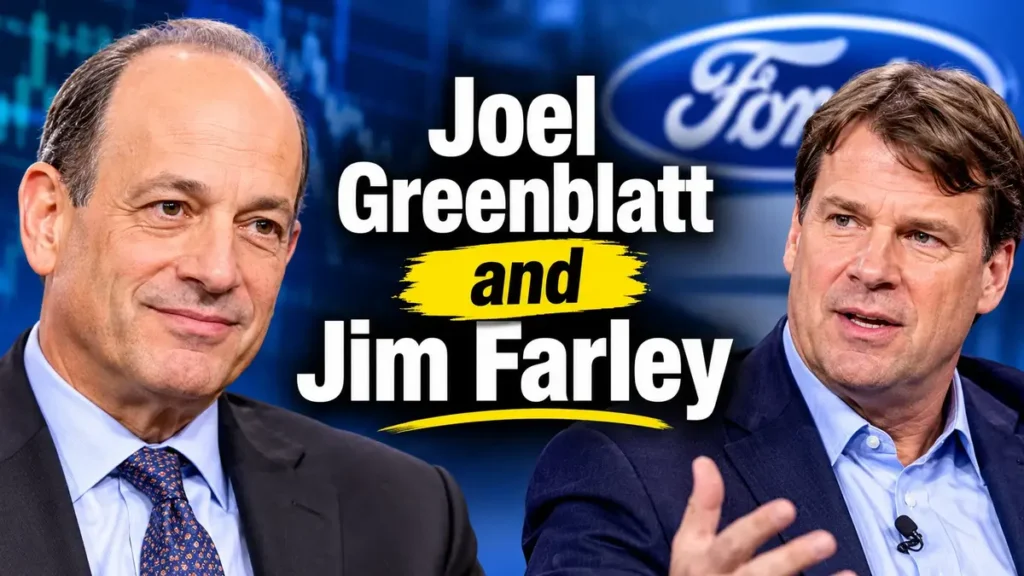
Investors struggle to connect Wall Street analysis with Detroit execution. You watch Ford’s stock swing wildly while EV headlines muddy the picture and leave you guessing. This guide maps exactly how the joel greenblatt and jim farley story bridges quantitative value investing with real-world automotive transformation, giving you clear signals to act on.
Full Article Chapter Map
| # | Section | Core Subject | Reader Benefit |
|---|---|---|---|
| 1 | Greenblatt’s Background | Gotham Capital origins and Wharton training | Understand the investor’s credibility |
| 2 | Farley’s Career Path | Toyota roots to Ford CEO appointment | See the operator’s track record |
| 3 | The Pairing Explained | Why these two names trend together | Connect investing to operations |
| 4 | Magic Formula Mechanics | Earnings yield plus ROIC ranking | Learn the stock-picking system |
| 5 | Ford’s Three-Unit Split | Blue, Model e, and Pro divisions | Read Ford’s financials clearly |
| 6 | Gotham’s SEC Filings | 13F position history in Ford shares | Track institutional conviction |
| 7 | Investor Meets Operator | Capital allocation vs. corporate execution | See both sides of the equation |
| 8 | Division Financials | Revenue and profit by segment | Compare unit-level performance |
| 9 | Valuation Stress Test | Magic Formula applied to Ford today | Judge the stock yourself |
| 10 | Risk Landscape | Headwinds threatening the thesis | Protect your downside |
| 11 | Retail Investor Lessons | Practical takeaways for your portfolio | Apply the framework immediately |
| 12 | Catalysts Ahead | Upcoming events that move the stock | Time your next decision |
Joel Greenblatt: The Quantitative Value Pioneer
Joel Greenblatt launched Gotham Capital in 1985 with $7 million in starting capital. Over the next two decades, the fund delivered annualized returns exceeding 40%, placing it among the most successful hedge funds in Wall Street history.
He earned both his bachelor’s degree and MBA from the Wharton School at the University of Pennsylvania by 1980. Greenblatt later spent over twenty years teaching value and special situation investing at Columbia Business School.
His writing made complex financial ideas accessible to everyday readers. The Little Book That Beats the Market introduced the Magic Formula to a mainstream audience and sold hundreds of thousands of copies worldwide.
Greenblatt’s professional milestones:
- Gotham Capital founding year: 1985
- Gotham Asset Management launch: 2010
- Columbia Business School tenure: 1996–2019
- Books published: 3 bestsellers on value investing
- Current role: Managing partner at Gotham Asset Management
Jim Farley: From Toyota Showrooms to Ford’s Corner Office
Jim Farley spent roughly 17 years at Toyota before Ford recruited him in 2007. At Toyota, he played a central role in building the Lexus brand across the United States, mastering the intersection of product quality and customer loyalty.
Ford elevated him to CEO on October 1, 2020, after he served in roles spanning global marketing, new business development, and corporate strategy. Farley inherited an automaker losing ground to Tesla and facing enormous pressure to electrify its lineup.
His first major move was the Ford+ plan, which restructured the company into three operating units. This decision gave Wall Street its first clear view of where Ford earned money and where it burned cash.
Farley’s career timeline:
- Toyota Motor North America: 1990–2007
- Ford Group VP of Global Marketing: 2007
- President of Global Markets: 2017
- Chief Operating Officer: 2020
- Ford President and CEO: October 2020–present
- McDonald’s Board of Directors: Joined February 2026
Joel Greenblatt and Jim Farley: Why This Pair Captures Attention
The joel greenblatt and jim farley connection matters because it sits at the crossroads of capital allocation and corporate execution. Greenblatt’s Gotham Asset Management accumulated Ford shares during periods when the market punished the stock for its EV spending.
Farley, meanwhile, made the operational decisions that determined whether those shares would eventually appreciate. One man evaluates the price tag. The other builds the product.
No public record confirms a direct advisory relationship or personal partnership between them. Their link exists through the shareholder registry and the broader narrative of value investors betting on legacy automaker turnarounds.
Why this pairing draws search interest:
- Gotham’s 13F filings show Ford as a recurring position
- Farley’s restructuring created the valuation gap Greenblatt targets
- Both figures represent opposing sides of the same financial equation
- Retail investors want to know if smart money backs Ford’s CEO
The Magic Formula Breakdown: Greenblatt’s Two-Metric System
Greenblatt’s Magic Formula ranks U.S. stocks using two simple inputs. The first is earnings yield, calculated by dividing EBIT by enterprise value. A higher earnings yield signals a cheaper stock.
The second metric is return on invested capital, or ROIC. This number divides EBIT by the sum of net working capital and net fixed assets. A higher ROIC signals a more efficient business.
Greenblatt combines both rankings to produce a single composite score. He then buys the top 30 stocks, holds them for one year, and repeats the process. The system removes emotion from stock selection entirely.
| Metric | Formula | What It Measures | Ideal Direction |
|---|---|---|---|
| Earnings Yield | EBIT ÷ Enterprise Value | How cheap the stock is | Higher is better |
| Return on Invested Capital | EBIT ÷ (NWC + Net Fixed Assets) | How efficiently the business uses capital | Higher is better |
| Composite Rank | Earnings Yield Rank + ROIC Rank | Overall Magic Formula score | Lower combined number is better |
| Portfolio Size | Top 30 U.S. stocks | Diversification across sectors | Rebalanced annually |
Ford Under Farley: The Three-Unit Restructuring
Farley’s boldest structural decision was splitting Ford into three separately reported divisions in March 2022. Ford Blue handles all internal combustion engine vehicles, including the F-150, Bronco, and Explorer.
Ford Model e covers electric vehicles, software platforms, and digital customer experiences. This division absorbed the heaviest investment spending and the largest operating losses during the early EV ramp.
Ford Pro serves commercial and government fleet customers with vehicles, telematics software, and charging solutions. This unit quickly became a profit standout that many analysts initially overlooked.
Ford’s operating structure at a glance:
- Ford Blue: ICE trucks, SUVs, and crossovers
- Ford Model e: Mustang Mach-E, F-150 Lightning, next-gen EVs
- Ford Pro: Transit vans, Super Duty fleets, software subscriptions
- Ford Credit: Auto financing and leasing operations
Gotham’s SEC Filings: Tracking Greenblatt’s Ford Position
Gotham Asset Management reports its holdings quarterly through SEC Form 13F filings. These public documents let any investor see exactly what Greenblatt’s firm owns.
Gotham increased its Ford stake during 2022 and early 2023 when the stock traded near multi-year lows. The firm trimmed the position later as the stock recovered and rebalancing rules triggered automatic adjustments.
This pattern reflects the Magic Formula’s mechanical nature. Greenblatt does not make emotional calls based on quarterly earnings surprises. The system buys when valuations compress and sells when rankings shift.
| Reporting Period | Approximate Ford Shares Held | Ford Price Range | Market Narrative |
|---|---|---|---|
| Q4 2021 | ~8.2 million | $18–$21 | EV euphoria peak |
| Q2 2022 | ~12.5 million | $11–$15 | Recession fears mount |
| Q4 2022 | ~15.1 million | $11–$13 | EV demand doubts grow |
| Q2 2023 | ~10.3 million | $12–$15 | UAW contract talks begin |
| Q4 2023 | ~7.4 million | $10–$13 | Strike disruption fades |
| Q2 2024 | ~5.6 million | $11–$14 | Hybrid pivot gains traction |
Approximate figures based on publicly available 13F data. Exact counts vary by filing date.
Joel Greenblatt and Jim Farley: Investor Meets Operator
The joel greenblatt and jim farley dynamic illustrates a fundamental truth about public markets. Investors like Greenblatt allocate capital based on financial metrics and valuation gaps. Operators like Farley make the daily decisions that create or destroy that value.
Greenblatt cannot control whether Ford’s next EV platform launches on time. Farley cannot control whether Gotham buys or sells shares on any given quarter. Each operates within a distinct sphere of influence.
What makes the joel greenblatt and jim farley pairing so compelling is the feedback loop between them. Farley’s cost cuts improve Ford’s earnings yield. Greenblatt’s formula detects that improvement and directs capital toward the stock. The cycle reinforces itself when execution matches expectations.
How the investor-operator loop works:
- Farley announces cost reductions or margin improvements
- Ford’s EBIT rises relative to enterprise value
- The Magic Formula ranking improves
- Systematic funds like Gotham increase allocations
- Institutional buying supports the share price
- Farley gains more financial flexibility to invest
Ford Division Financials: Revenue and Profit Compared
Ford’s segmented reporting gives investors a transparent look at where money flows. The numbers tell a clear story: Ford Blue and Ford Pro fund the Model e transition.
Ford Blue generated roughly $110 billion in revenue during 2023, driven by strong F-Series truck sales and healthy SUV demand. Ford Pro contributed approximately $5.9 billion in revenue with impressive margins from software subscriptions.
Ford Model e reported around $5.2 billion in revenue but posted operating losses exceeding $4.7 billion. Farley acknowledged these losses publicly and began adjusting production volumes to match actual customer demand.
| Division | 2023 Revenue | 2023 Operating Income | Margin Trend | Key Products |
|---|---|---|---|---|
| Ford Blue | ~$110B | ~$7.5B | Stable | F-150, Bronco, Explorer |
| Ford Model e | ~$5.2B | –$4.7B | Improving slowly | Mach-E, Lightning |
| Ford Pro | ~$5.9B | ~$7.2B | Expanding | Transit, Super Duty, software |
| Ford Credit | ~$10.3B | ~$2.9B | Steady | Auto loans, leases |
Data sourced from Ford Motor Company Q4 2023 earnings disclosures.
Valuation Stress Test: Does Ford Pass the Magic Formula Today?
Running Ford through the Magic Formula produces a split verdict. The earnings yield component scores exceptionally well because Ford trades at a low enterprise value relative to its operating earnings.
The ROIC component creates friction. Auto manufacturing demands massive capital investment in assembly plants, battery facilities, and R&D programs. Ford’s capital base inflates the denominator and compresses its return metric.
Farley’s restructuring directly targets this weakness. By growing the asset-light Ford Pro software business and improving manufacturing efficiency at BlueOval plants, he aims to push ROIC upward over the next three to five years.
Ford’s Magic Formula scorecard:
| Factor | Current Status | Trend | Magic Formula Impact |
|---|---|---|---|
| Earnings Yield | Top 15% of U.S. stocks | Stable | Strong positive |
| ROIC | Mid-pack for industrials | Improving | Moderate drag |
| Enterprise Value | Below historical average | Slight increase | Supports cheap valuation |
| EBIT Margin | ~6–7% consolidated | Rising in Pro | Positive trajectory |
| Capital Intensity | High due to EV buildout | Peaking now | Temporary headwind |
Joel Greenblatt and Jim Farley: Risks Worth Understanding
The joel greenblatt and jim farley thesis faces real headwinds that honest analysis must address. EV demand growth has decelerated across the entire industry, not just at Ford. Consumers are choosing hybrids over fully electric models at higher rates than automakers predicted.
Chinese manufacturers like BYD produce electric vehicles at price points that Western companies struggle to match. Even with tariff protections, the competitive pressure on margins remains intense and growing.
The 2023 UAW contract added significant labor costs that will weigh on Ford’s profitability through 2028. Farley must absorb these expenses while simultaneously funding the EV transition and maintaining dividend payments.
Primary risk factors:
- EV adoption pace falling short of industry forecasts
- Chinese automaker expansion into global markets
- UAW labor costs compressing operating margins
- Battery raw material price volatility
- Potential recession reducing truck and SUV demand
- Technology obsolescence in EV battery chemistry
What Retail Investors Can Learn From This Story
The joel greenblatt and jim farley narrative offers five practical lessons you can apply to any stock in your portfolio. These principles work whether you follow the Magic Formula or build your own research process.
1. Separate the business from the stock price. A well-run company is not automatically a good investment at every valuation. Greenblatt’s entire career proves that price matters just as much as quality.
2. Read the filings yourself. Gotham’s 13F reports and Ford’s 10-K documents contain more useful information than any cable news segment. Primary sources beat commentary every time.
3. Understand the operator’s incentives. Farley’s compensation ties directly to Ford’s stock performance and operational targets. When management’s wealth aligns with shareholders, execution tends to improve.
4. Respect the time horizon. Turnarounds in capital-intensive industries take years, not quarters. Greenblatt holds Magic Formula positions for a full year minimum, and Farley’s Ford+ plan extends through 2026 and beyond.
5. Accept that formulas have limits. The Magic Formula provides a starting point, not a guarantee. Market conditions shift, accounting rules change, and black swan events ignore every spreadsheet.
Joel Greenblatt and Jim Farley: Future Catalysts to Watch
The joel greenblatt and jim farley story enters its next chapter as Ford prepares several major product and financial milestones. These events will test whether Farley’s operational improvements translate into the valuation gains Greenblatt’s framework anticipates.
Ford plans to launch its next-generation affordable EV platform between 2026 and 2027. This vehicle targets a lower price point than the F-150 Lightning and aims to compete directly with mass-market electric offerings.
Ford Pro’s subscription revenue continues to climb as fleet customers adopt telematics and charging management tools. This high-margin stream could reshape Ford’s overall profitability profile within three years.
Upcoming catalysts timeline:
| Event | Expected Timing | Potential Stock Impact |
|---|---|---|
| Next-gen affordable EV reveal | 2026–2027 | High if pricing competitive |
| BlueOval City full production | 2026 | Moderate to high |
| Ford Pro $10B revenue milestone | 2026–2027 | High for margin narrative |
| EV division breakeven target | 2027–2028 | Very high if achieved |
| Hybrid lineup expansion | 2025–2026 | Moderate positive |
| Potential share buyback increase | Ongoing | Moderate support |
Frequently Asked Questions
What connects joel greenblatt and jim farley in the investment world?
The joel greenblatt and jim farley link centers on Gotham Asset Management’s Ford stake during Farley’s CEO tenure. Greenblatt’s Magic Formula identified Ford as undervalued while Farley executed the operational turnaround that could unlock that value. No direct personal partnership exists between them.
Does the Magic Formula currently favor Ford stock?
Ford scores well on earnings yield due to its low valuation multiples. Its ROIC remains moderate because of capital-intensive EV investments. The combined ranking places Ford in a competitive but not dominant position within the Magic Formula universe.
Why do investors follow the joel greenblatt and jim farley narrative?
The joel greenblatt and jim farley narrative gives retail investors a clear framework for evaluating Ford. Greenblatt represents disciplined capital allocation. Farley represents operational execution. Together, they embody the two forces that drive long-term stock returns.
How large is Gotham’s current Ford position?
Gotham Asset Management’s most recent 13F filing on SEC EDGAR shows a Ford position that fluctuates quarterly. The firm adjusts holdings mechanically based on Magic Formula rankings rather than making discretionary bets on individual stocks.
What is Jim Farley’s biggest challenge at Ford?
Farley must reduce Ford Model e losses while maintaining Ford Blue profitability and growing Ford Pro margins. Balancing these three divisions during a period of slowing EV demand and rising labor costs represents the central test of his leadership.
Can retail investors replicate Greenblatt’s Ford strategy?
Yes. The Magic Formula methodology is publicly available in Greenblatt’s books and on his website. Any investor can screen for high earnings yield and high ROIC stocks using free financial data tools and apply the same systematic approach Gotham uses.
Your Next Move Starts Now
The joel greenblatt and jim farley story offers more than an interesting comparison between a Wall Street quant and a Detroit CEO. It gives you a working template for evaluating any company caught between legacy strength and future disruption.
Open SEC EDGAR and pull Gotham’s latest 13F filing. Download Ford’s most recent 10-K from their investor relations page. Run the earnings yield and ROIC calculations yourself using the Magic Formula framework outlined above.
Stop letting headlines make your investment decisions for you. Start building conviction through primary data, disciplined analysis, and the same patient approach that Greenblatt has practiced for nearly four decades. The numbers are public, the framework is free, and the only variable left is your willingness to do the work.